Systems × machine learning
I design distributed intelligence for places where bandwidth, compute, and response time are limited.
My research spans task-informed neural compression, progressive inference, and community-scale digital twins for environmental monitoring and disaster resilience.
- Edge Computing
- Split Computing
- Neural Compression
- Progressive Inference
- Digital Twins
- Computer Vision
PhD in Computer Science
University of California, Irvine
Master of Computer Science
California State University San Marcos
Bachelor of Mathematics
University of California, Santa Barbara
Make split inference practical when bandwidth is the bottleneck.
I build adaptive neural compression and progressive inference systems that preserve task utility while reducing what mobile sensors need to transmit.
Connect perception models to operational digital twins.
My SHIELD work links edge sensing, simulation, and visualization for wildfire intelligence and community-scale decision support.
Deploy computer vision in constrained field settings.
Recent projects span UAV wildfire monitoring, wildlife detection, smart waste systems, VR lab tracking, and geospatial trail mapping.
Under review
Modulated Adaptive Neural Compression for task-informed split computing
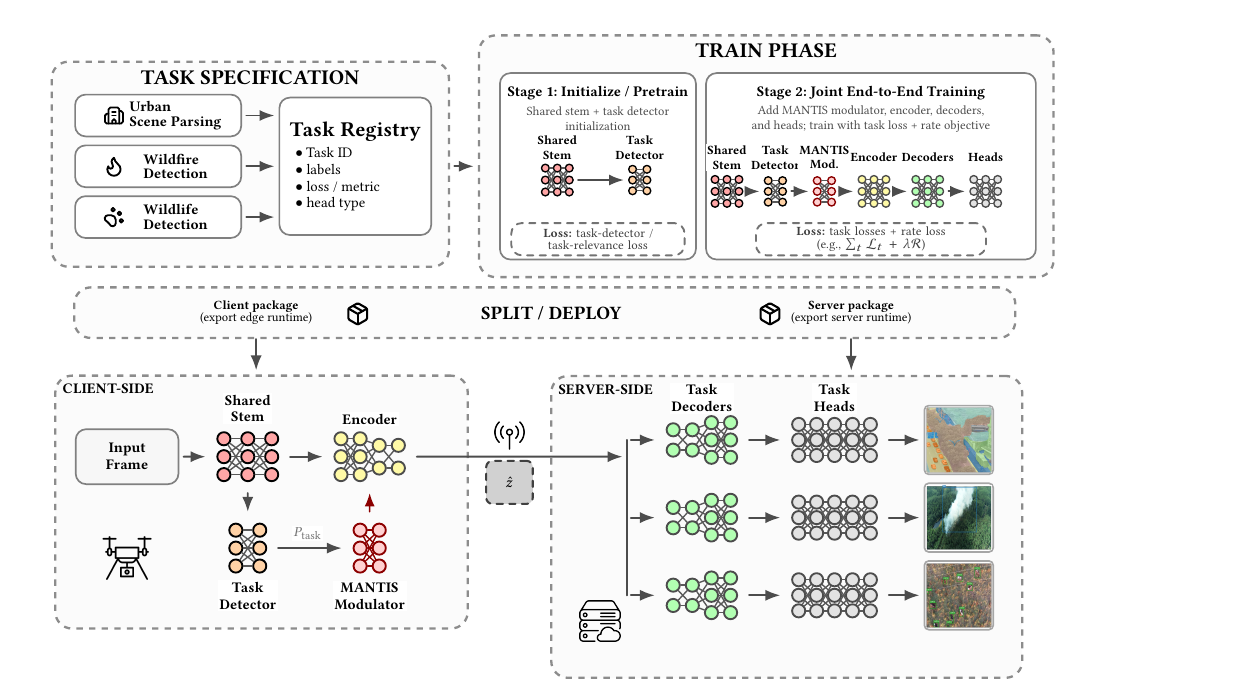
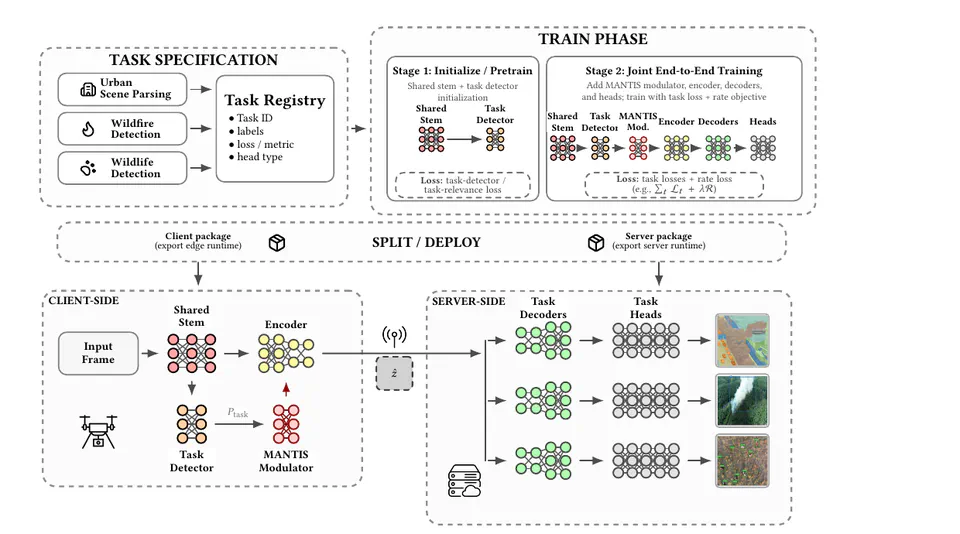
MANTIS moves task awareness to the client side of a UAV split-computing pipeline. A lightweight task detector estimates the current mission objective, conditional GDN reshapes the compressed latent before entropy coding, and the edge server routes compact task-shaped features to task-specific heads.